Alternative Access
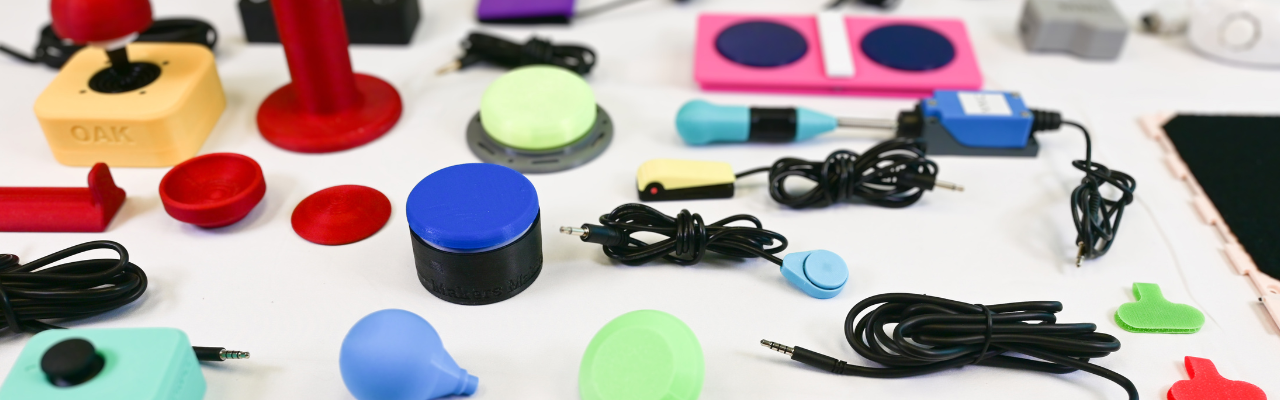
Various MMC Assistive Switches and Joysticks
What is Alternative Access
Alternative Access referes to using any type of input into a game that does not involve using a "standard controller". In this case "standard controller" means the default controls that come with the system. This could be keyboard/mice or Xbox/Nintendo/PlayStation controllers.
This section will provide an overview on all the devices and tools mentioned above as well as giving a quick overview of the platforms available.
Adaptive Controllers
For the purpose of this resource, we are going to define adaptive controllers as anything built or designed for gaming platforms that either take a significantly different shape and/or allow assistive switch and/or joystick access.
There are three primary adaptive controllers out there with various approaches to making gaming more accessible. We like to divide them into Hub Based Controllers or Direct-Use Controllers. The difference is:
- Hub Based Controllers: Require other assistive technology to be plugged into it to create a setup. This is just the bridge between the assistive technology and the platform you are trying to game on.
- Direct-Use Controllers: Designed to be used without or with little addition of other assistive technology. The controller often takes a significantly different shape than the standard controller and has various joysticks and buttons built into it.
Adaptive Controllers Comparison
| Controller | Visual Reference | Approx Cost (CAD) | Category & Compatibility* | Key Features & Technical Details |
|---|---|---|---|---|
| Xbox Adaptive Controller (XAC) | 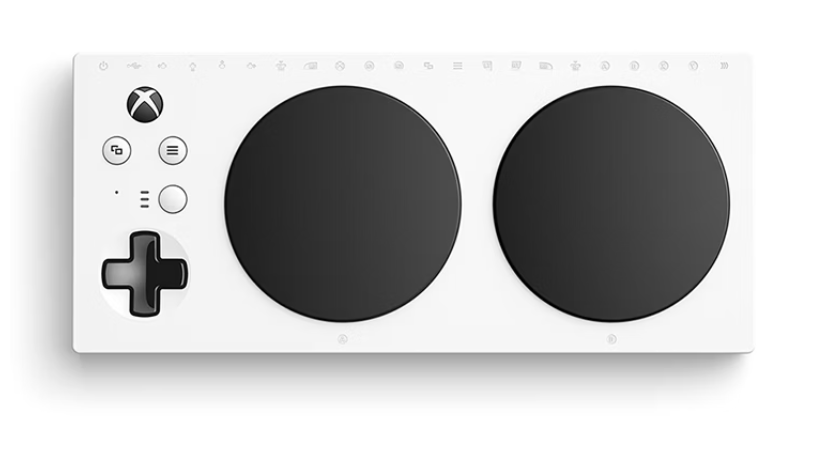 |
$129.99 | Type: Mostly Hub Based Compatibility: Natively compatible with Xbox One, Xbox Series X|S, computers, and phones/tablets. |
Show Detailed Info
|
| Sony Access Controller (SAC) | 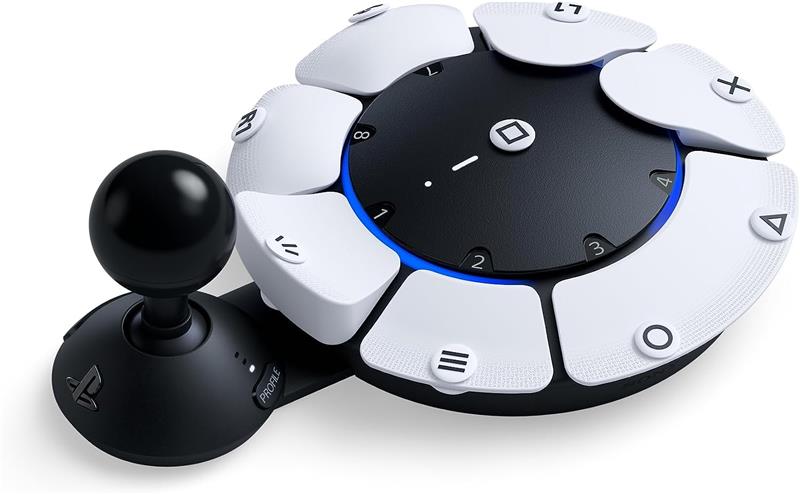 |
$99.97 | Type: Mostly Direct-Use Compatibility: ONLY compatible with the PS5 natively. |
Show Detailed Info
|
| Hori Flex Controller | 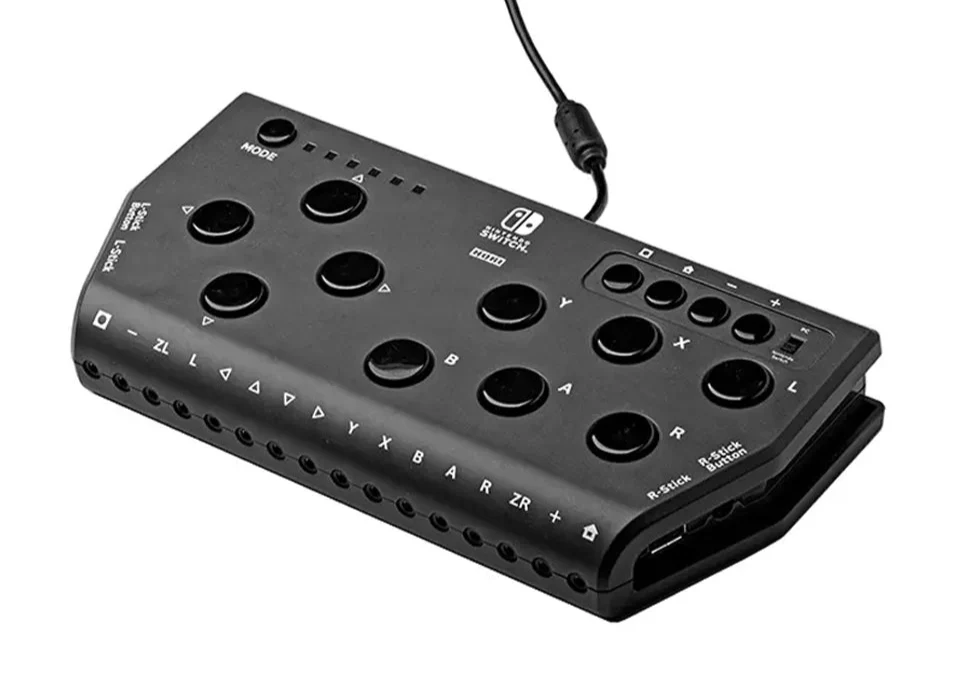 |
$440.00 | Type: Hybrid (Hub/Direct-Use Mix) Compatibility: Connects to Nintendo Switch 1 and 2 natively. |
Show Detailed Info
|
*Compatibility in this table is only referring to what the device was designed to connect with. However, you can use adapters to get these adaptive controllers to connect to nearly any platform. See the adapters section.
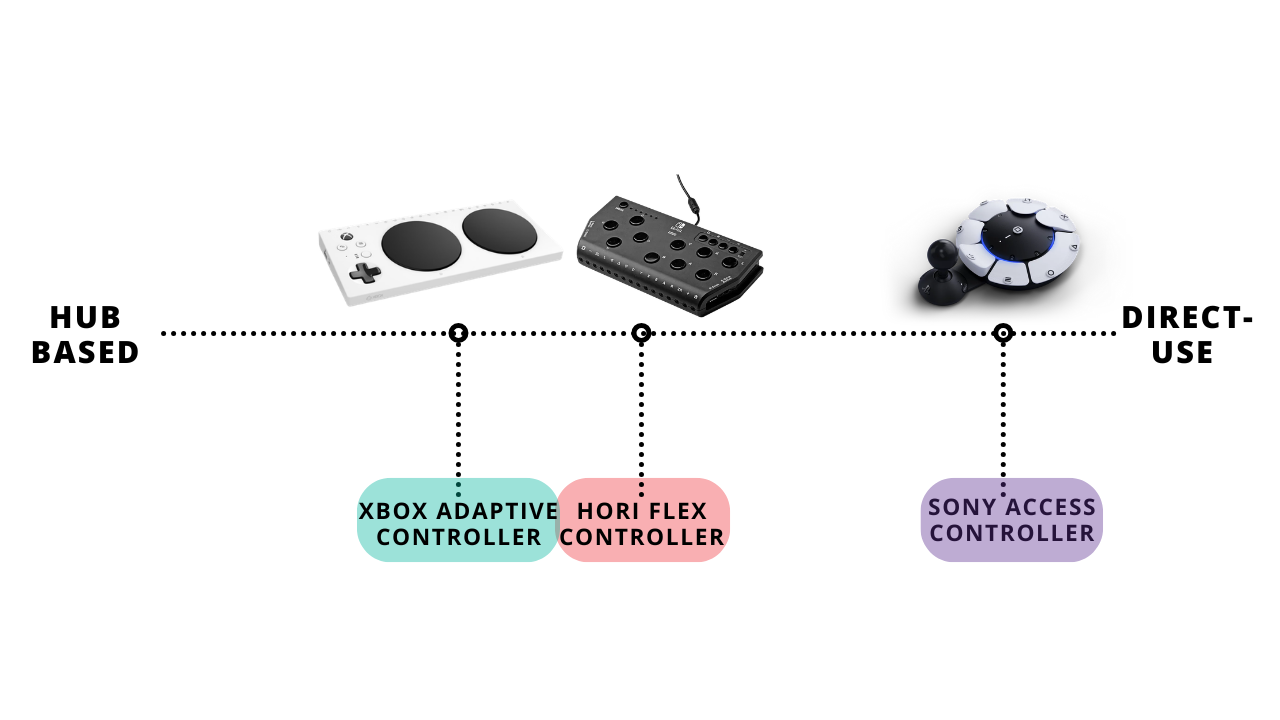
Spectrum of Hub Based and Direct-Use Based Adaptive Controllers
See each section below for more specific information on the adaptive controllers.
Xbox Adaptive Controller (XAC)
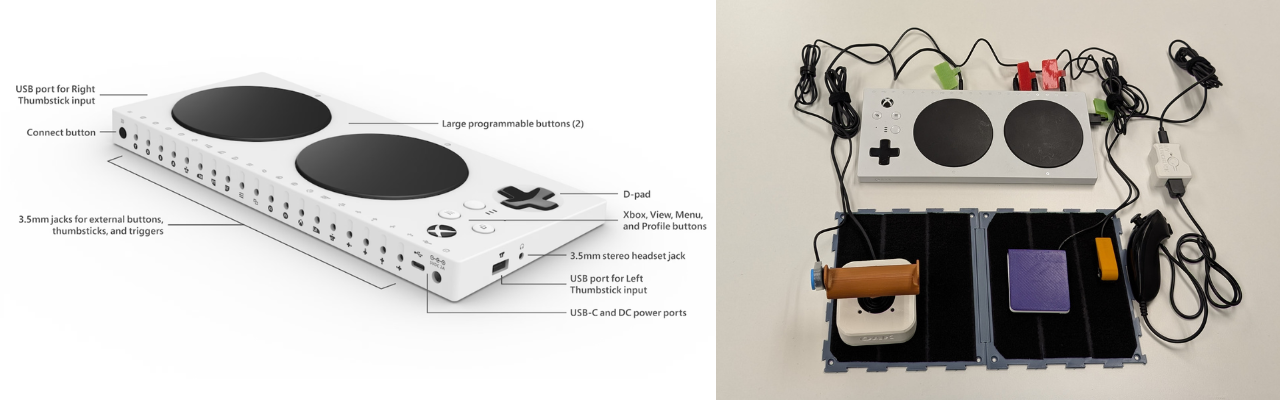
Released in 2018 with ongoing updates (even today), the Xbox Adaptive Controller (XAC) is a very powerful device with many applications. It could even be used as a bridge to use assistive technology to access a computer for personal use or employment. The XAC features some buttons on its face for usage out of the box but also has 3.5 mm and USB ports to add more assistive technology. Acting as a hub to create a custom adaptive gaming setup.
How to Get Started
Xbox has a fantastic series of videos and online resources explaining every feature on the XAC alongside player profiles where players using the XAC describe their setup.
Check out the XAC Resources Created by Xbox

Scan to go to the XAC web resources created by Xbox
Check out the first video in Xbox's resource series here:

Scan to go to the Video XAC resources created by Xbox
SpecialEffect also has a fantastic walkthrough of setting up an XAC on an Xbox Console:

Scan to go to the SpecialEffect XAC Setup
Key Features
Key Features of the Xbox Adaptive Controller (XAC)
| Feature | What Does it Do | Use Case | Learn More |
|---|---|---|---|
| Assistive Switches and Joysticks | • The main feature of the XAC is being able to plug in 3.5 mm assistive switches and 3.5 mm or USB joysticks to create a custom setup | • If the built in buttons do not work for the player or they need additional input. | Found in: Video: XAC Guide - Getting Started |
| Controller Remapping | • Each 3.5 mm port on the back of the XAC is labeled with a specific input. For example, you plug in an assistive switch to the A port, it will act as A. • However, you can use the Xbox Accessories App to reassign (remap) that button to any button or action available in the Xbox. |
• You want to use the features such as toggle, shift, axis swap, etc. that are available in the Xbox Accessories App. You would set this up through the remapping process and save it. | Found in: Video: XAC Guide - Customization with the Xbox Accessories App |
| Profile Saving | • You can save various remapping settings you have made for various games • You can save as many profiles as you want but you can only save 3 to the controller at a time to hotswap between. There is a button on the XAC to swap between the three profiles that can also be accessed by an assistive switch. |
• You play a racing game, fighting game, and first person shooter. Instead of unplugging and replugging or remapping all the time, you can save the profile that works for that game once. | Found in: Video: XAC Guide - Customization with the Xbox Accessories App |
| Controller Assist (previously co-pilot) | • This allows two controllers to act as one. Either two XAC's, standard controllers, or a standard controller and an XAC working together. | • One player does some of the inputs with the standard controller while the other uses the custom setup with the XAC to use those inputs. | Found in: Video: XAC Guide - Getting Started |
| Button Toggle | • You can assign any button input to stay activated with a single press. Then press again to turn off. Think about a light switch. | • For users that do not want to hold a button down to keep it activated. Aiming in first person shooter games is a great example. Press once to aim, press again to put the weapon down. | Found in: Video: Gaming Readapted |
| Shift Mode | • Shift allows you to assign two different functions to a single joystick or button. | • You must choose an input (button or joystick) to make your shift button • The Shift key also allows you to assign two different functions to a single button. You can remap a button to be the A button A by default, but when holding the Shift key, your A button now functions as the B button when you press it. |
Video: XAC Guide - Advanced functionalities |
| Joystick Axis Swap | • When remapping, if you select one of the joysticks it will allow you to swap either or both the X and Y axis. | • This allows the gamer to play a game that requires 2 joysticks with one. • For example, if they were using a left joystick and swapped the X axis with the right joystick, they could move forward and back in a 3rd person game and use the left and right to look around and move in all directions. |
n/a - No resource yet |
| Joystick Sensitivty Curves | • Adjusting the sensitivity of the joystick plugged into the XAC. | • For example, players who have limited strength or mobility can choose a sensitivity curve option that provides an experience where less physical movement of the joystick is needed to achieve the same amount of in-game character or camera movement. | Video: XAC Guide - Advanced functionalities |
| Mounting | • 1/4-20 screw designed for AMPS compatible mounts. °-20 screw designed for tripod mounts. | • Placeing the controller in a more optimal position for the player | N/A |
Sony Access Controller (SAC)
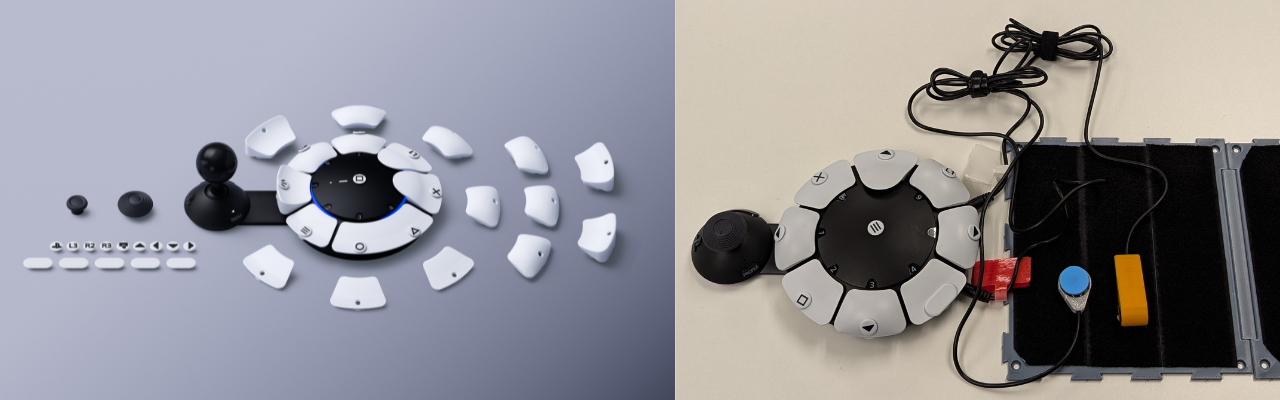
Released in 2023, the Sony Access Controller took a different approach to the adaptive controller than both the XAC and Hori Flex Controller by attempting to create an out-of-the-box ready to play adaptive controller. This is a great option for some players but in other ways, its lack of customization in shape and limited amount of ports for additional assistive tech may not be enough for some.
How to Get Started
PlayStation has a fantastic series of videos and online resources explaining every feature on the SAC. The SAC also does a great job of walking the player through using the controller during first setup/launch on the system. This is by far the most intuitive adaptive controller.
Check out the SAC Resources Created by PlayStation

Scan to go to the SAC web resources created by PlayStation
Check out the SAC setup and unboxing video:

Video: SAC Setup and Unboxing
Check out the SAC controller customization video:

Video: SAC Controller Customization
Key Features
Key Features of the Sony Access Controller (SAC)
| Feature | What Does it Do | Use Case | Learn More |
|---|---|---|---|
| Swappable Button Caps | • The SAC comes with various cap shapes (pillow, flat, curved, and overhang) that magnetically attach to the buttons. • Includes a "wide flat" cap that can cover two button sockets at once. |
• A user needs a larger target area for a specific action. • Use the overhang caps for players who find it easier to pull a button rather than push it. |
Button Caps Resource |
| Built-in Joystick | • A built-in analog stick that can have the cap swapped (standard, dome, or ball) and the arm length adjusted. • The orientation is 360° adjustable; you can set "North" to be any direction via the PS5 settings. |
• A player is mounting the controller at an angle or upside down and needs the stick to still respond correctly to "Up/Down" movements. • Adjust the arm length to meet the player's reach. |
Built-in Joystick Resource |
| Expansion Ports | • A total of four 3.5 mm expansion ports allowing for assistive switch or joystick (no USB) access • Up to four assistive switches or up to 2 joysticks |
• If the built in joysticks or buttons do not work for the player or they need additional input. | Expansion Ports Resource |
| Secondary Controller | • Allows up to three controllers to be paired as a single controller. This can include two Access controllers and one DualSense wireless controller. • All connected controllers can be used simultaneously to navigate menus and play games. |
• A secondary user uses a DualSense controller to handle complex movements (like camera control) while the player uses one or two SACs for primary actions. • Two Access controllers are used together to create a full 360-degree button layout for a single player. |
Secondary Controller Resource |
| Controller Remapping | • Software-level customization that allows you to change what every physical button does on the PS5 system. • Allows for disabling buttons entirely to prevent accidental presses. |
• You need to move a vital function (like R2) from a trigger to a large, accessible button on the SAC deck. • Simplify a game by removing unused inputs that might cause frustration. |
How to set Access Controller Mapping |
| Profile Saving | • You can save various remapping settings you have made for various games. • You can save as many profiles as you want but you can only save 3 to the controller at a time to hotswap between. There is a button on the SAC to swap between the three profiles that can also be accessed by an assistive switch. |
• You play a racing game, fighting game, and first person shooter. Instead of unplugging and replugging or remapping all the time, you can save the profile that works for that game once. | How to set Access Controller Mapping |
| Simultaneous Press | • Allows a single physical button to act as two button presses at the same time (e.g., L1 + R1). • The wide flat button cap can also be used to physically bridge two separate button sockets. |
• Useful for fighting games or shooters where "Ultimate" abilities require pressing two buttons simultaneously. • Helps users with limited coordination who struggle to hit two separate targets at once. |
How to set Access Controller Mapping |
| Button Toggle | • You can assign any button input to stay activated with a single press. Then press again to turn off. Think about a light switch. | • For users that do not want to hold a button down to keep it activated. Aiming in first person shooter games is a great example. Press once to aim, press again to put the weapon down. | How to set Access Controller Mapping |
| Joystick Sensitivity and Deadzone | • Adjusts how much physical movement is required to trigger an in-game action. • Deadzone settings allow you to tell the console to ignore small, accidental "drifts" or tremors. |
• A player has very limited range of motion and needs the stick to be "highly sensitive" so a small twitch results in a full movement. • A player with tremors needs a larger "deadzone" so the camera doesn't shake. |
How to set Access Controller Mapping |
| Mounting | • Two 10-24 screw holes for securely attaching the controller to mounts with an AMPS hole pattern. • One 1/4-20 hole located near the center of the controller to mount the controller to tripods or any mounts compatible with this screw hole. |
• Placing the controller in a more optimal position for the player, such as on a wheelchair tray or a camera tripod. | Mounting Resource |
Video: SAC Controller Customization

Video: SAC Expansion Ports

Video: SAC Secondary Controller

Video: SAC Controller Mounts
Hori Flex Controller
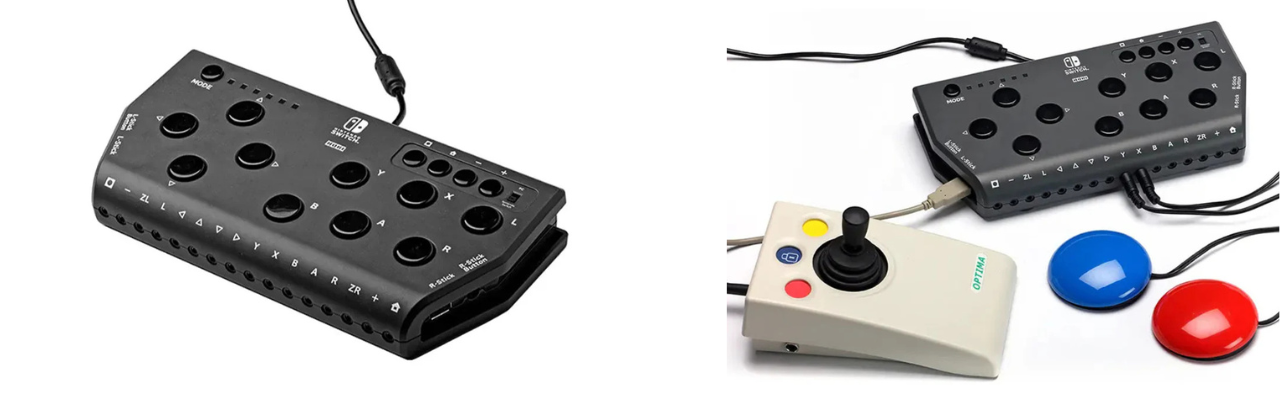
The Hori Flex is a unique hybrid controller designed primarily for the Nintendo Switch (though it is also compatible with PC). It bridges the gap between the XAC and the SAC by offering a significant number of built-in buttons on the top of the device while still providing 3.5 mm ports for external switches and USB ports for joysticks. Notably, it is the only major adaptive controller that offers dedicated eye-tracking accessibility features right out of the box.
How to Get Started
Hori provided a detailed manual and others like SpecialEffect and Gaming Readapted have made fantastic video tutorials.
Download the Hori Flex Controller Manual

Link: Hori Flex Manual
Check out the SpecialEffect Hori Flex introduction and setup guide:

Video: SpecialEffect Hori Flex Setup
Gaming Readapted also provides a great overview of how the Hori Flex integrates with the Nintendo Switch:

Video: Gaming Readapted Hori Flex Setup
Key Features
Key Features of the Hori Flex Controller
| Feature | What Does it Do | Use Case | Learn More |
|---|---|---|---|
| Hybrid Input Design | • Features 18 assignable 3.5 mm switch ports and 2 USB ports for joysticks (no 3.5 mm). • Includes a small array of physical buttons on the face of the device for direct use. |
• A user needs the "Hub" capability of the XAC but also wants a few physical buttons on the device for menu navigation or simple actions. | SpecialEffect - Hori Flex |
| Eye-Tracking Interface | • Features a dedicated interface that allows the controller to be operated via compatible eye-tracking devices on the PC. | • For players with very limited physical mobility who rely on eye-gaze technology to interact with their environment and games. | SpecialEffect - Hori Flex |
| Flex Controller Settings App | • A dedicated PC application used to remap buttons, adjust joystick sensitivity, and configure deadzones. | • You need to customize the "active" range of a joystick or change the behavior of a specific switch port for a Nintendo Switch game. | SpecialEffect - Hori Flex |
| On-Board Profile Storage | • Allows you to store multiple mapping configurations directly on the hardware. • Profiles can be toggled using a physical button on the controller. |
• A user frequently switches between games like Mario Kart and The Legend of Zelda and needs instant access to different button layouts. | SpecialEffect - Hori Flex |
| Mounting | • Features a standard 1/4-20 threaded hole on the bottom of the device. | • Securely mounting the controller to a camera tripod or a magic arm for positioning near the head or lap. | SpecialEffect - Hori Flex |
Video: SpecialEffect Hori Flex Setup
Cost Consideration
The Hori Flex controller is significantly more expensive than the other options. With the XAC providing very similar functions, compatibility with more devices (phones and computers), and a more dynamic remapping and customization software, consider purchasing an XAC with an adapter that allows it to connect to a Nintendo Switch 1 or 2.
However, if the player wants eye tracking software compatibility specifically, that may shift the decision to the Hori Flex Controller.
Other Adaptive Controllers
There are also a few other adaptive controllers out there. These typically only connect to phones and computers for gaming. This resource only touches on these briefly but see the table below for a few of the key options out there. The main reason someone may consider these options over the XAC, SAC, or Hori Flex is potentially due to reduced cost or customization available if they are open source and allow the user to customize the programming of the device.
Other Adaptive Controllers Comparison
| Controller | Visual Reference | Approx Cost (CAD) | Category & Compatibility* | Key Features & Technical Details |
|---|---|---|---|---|
| Forest Hub | 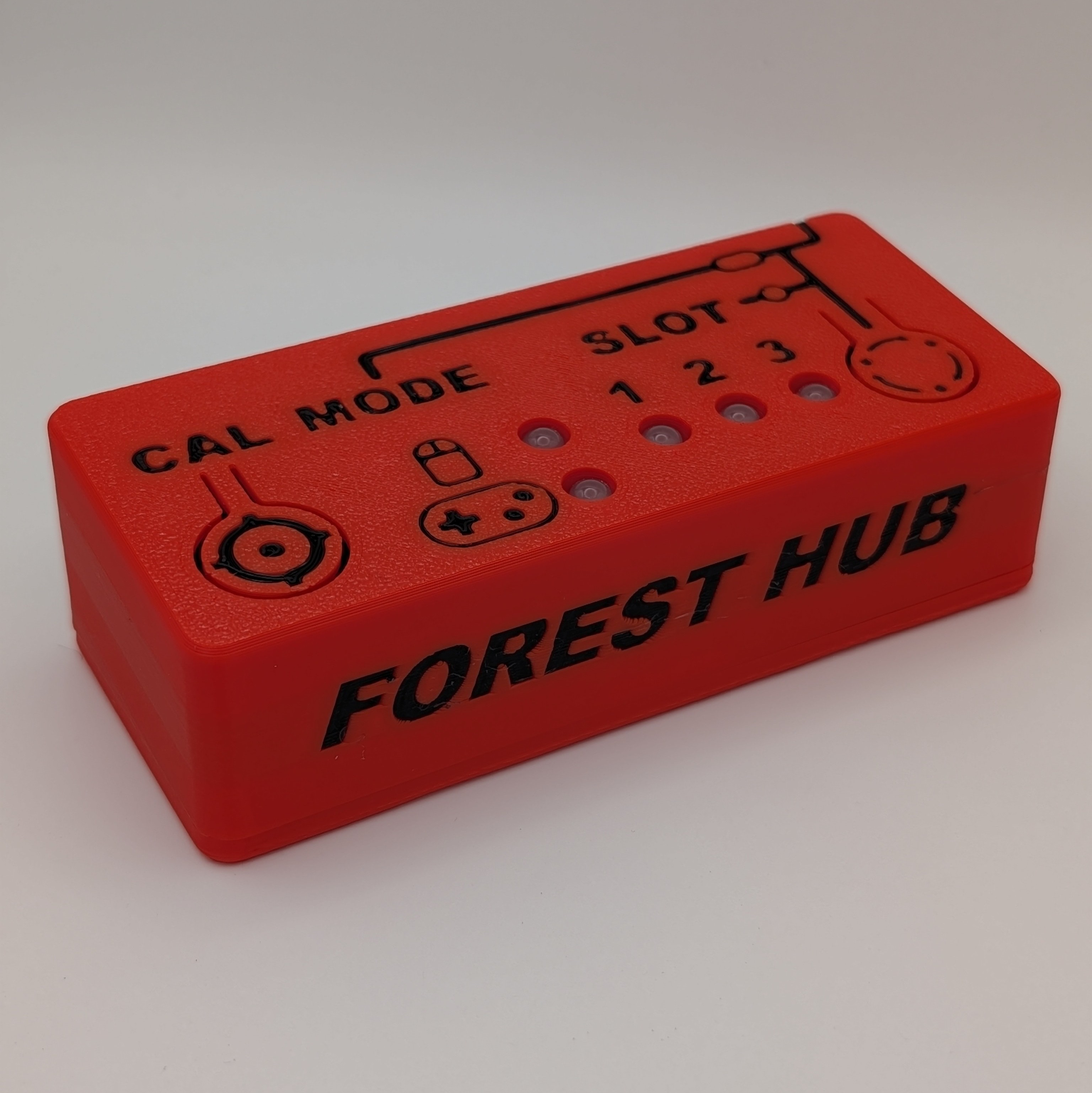 |
~$75-150 | Type: Hub Based Compatibility: Natively compatible with PC, tablets, and phones. Can be connected to XAC through left or right USB port. |
• Enables a user to connect an analog joystick (TRRS) and up to four (4) assistive switches to emulate a USB Mouse or USB Gamepad. Another assistive switch can be used to cycle between slots and switch between Mouse and Gamepad mode. |
| Quester Switchbox |  |
~$265.00 | Type: Hub Based Compatibility: Natively compatible with conputers and Android mobile devices. Works with Xbox via XAC USB ports. |
• A "plug-and-play" interface that converts up to six (6) assistive switches into standard gamepad or mouse inputs. • Features an integrated display to show the current mode and requires no external software for configuration, making it ideal for clinical environments with restricted IT/software installation rights. |
| HID Remapper | 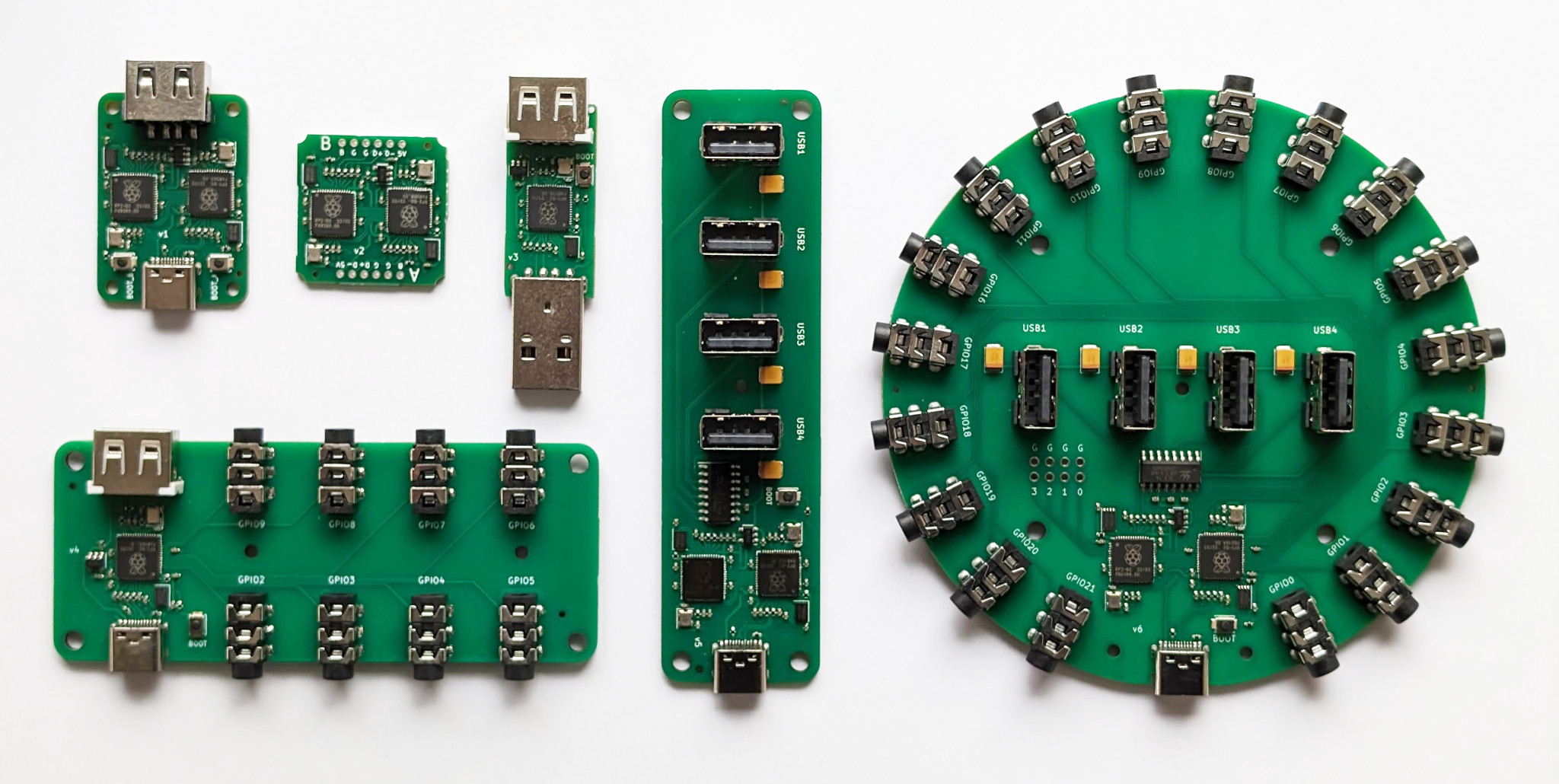 |
N/A - Depends on the type of remapper and manufacturing costs | Type: Universal Adapter / Hub Compatibility: Broad; connects almost any USB input device to PC, consoles (via adapters), and mobile. |
• A powerful open-source tool that allows for hardware-level remapping of any USB HID device. It can combine multiple controllers into one or split one controller across several outputs. • Supports advanced logic like macros, layers, and custom sensitivity curves stored on the hardware, bypassing the need for background software. |
*Compatibility in this table is only referring to what the device was designed to connect with. However, you can use adapters to get these adaptive controllers to connect to nearly any platform. See the adapters section.
Specialized Controllers
The distinction between Specialized Controllers and Adaptive Controllers is that adaptive controllers often act as a "hub" or intermediary between assistive technology and a platform. In contrast, specialized controllers are designed from the ground up with a specific form factor or function in mind. For example, to allow for one-handed use, modular building, or ultra-low-force interaction, etc.
Byowave Proteus
The Proteus is a modular, "snap-and-play" controller system. It uses magnetic cubes and peripheral parts that allow a user to build a controller in whatever shape they need.
Check out the Byowave Controllers
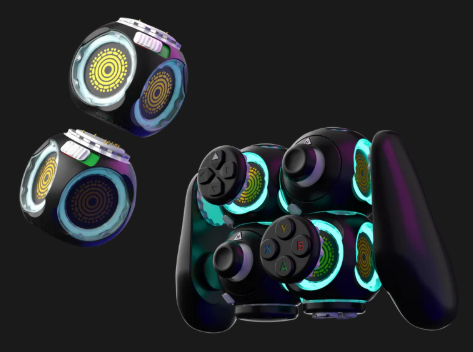
Byowave Proteus Kit
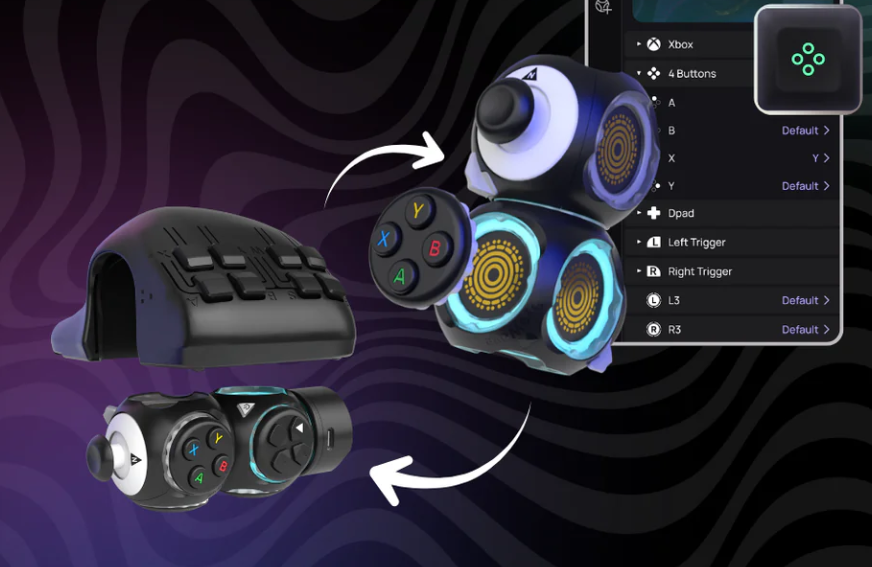
Byowave Proteus Builder
| Controller | Key Features |
|---|---|
| Proteus Controller Kit | • Snap magnetic modules together to create unique shapes. • Akimbo Mode: A firmware update that allows two separate Proteus "Power Cubes" to work together as a single controller on one USB dongle. • Compatibility: Works natively with Xbox, PC, and Steam Deck. |
| Proteus Controller Builder | • Includes two of the cubes from the Proteus Kit and a 3D printed shell that is designed for one handed gaming. |
Nhuad One-Handed Controller
The Nhuad Controller is designed to place every function of a standard controller—including two analog sticks and all triggers for one handed gaming.
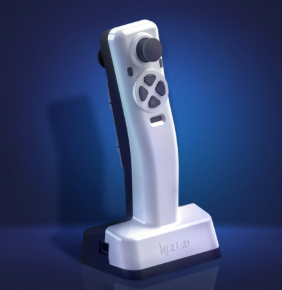
Nhuad Controller Front View
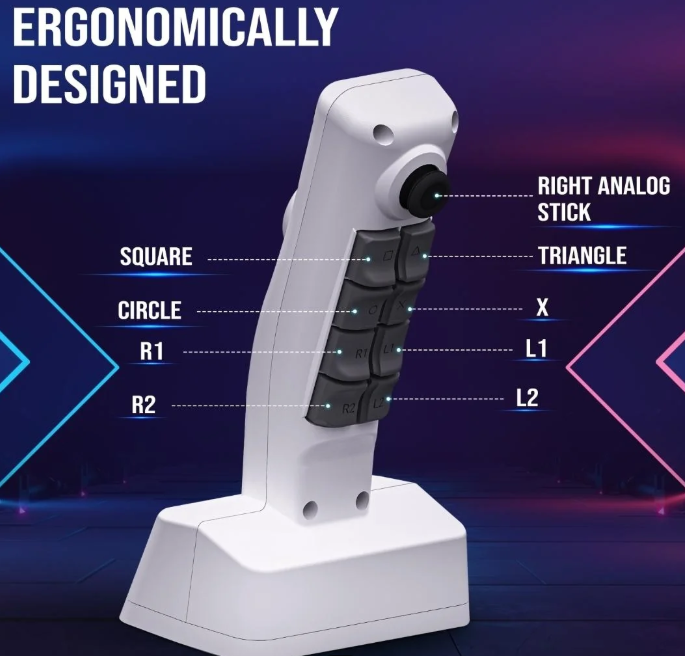
Nhuad Controller Rear View
| Controller | Key Features |
|---|---|
| Nhuad Controller | • One Hand Use: The design creates a layout to be fully operable with one hand. • Non Directional: Can be configured for either left or right-hand use. • Compatibility: Compatible with PC, PS4/PS5, and Xbox. (with adapters) |
Azeron Controllers
Azeron devices are intended for one handed gaming. They have a variety of products that use keyboard and mouse input. Some of these units are adjustable as well. These are only compatible with systems compatible with mouse and keyboard inputs.
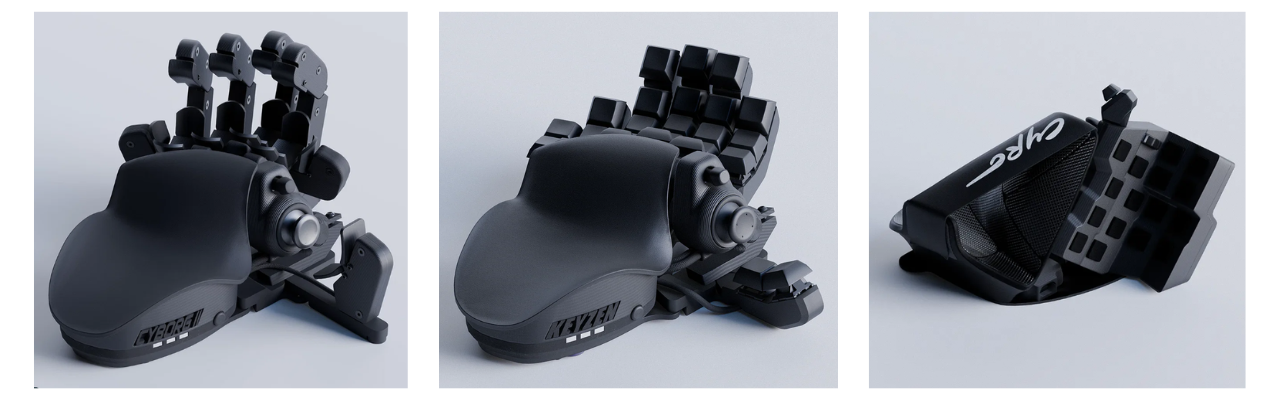
Azeron Cyborg 2 (left), Azeron Keyzen, Azeron (middle), Cyro (right)
| Controller | Key Features |
|---|---|
| Cyborg 2 | • Maximum Adjustability: The flagship model with 29 programmable keys and the most points of articulation for a perfect ergonomic fit. |
| Cyborg 2 Compact | • Low Profile: Features the same electronics and thumbstick as the Cyborg 2 but with a fixed, lower-profile button layout for users who prefer less vertical reach. |
| Keyzen | • Standard Keyboard Hybrid: Designed for those who want the Azeron ergonomics but in a more traditional keypad layout without the thumbstick. |
| Cyro | • Different Shape: A smaller and angled wrist placement with an array of buttons and a joystick for mouse/keyboard inputs. • Great for two joysticks: Also has a mouse sensor so the player can move it around on the table to get one joystick motion and use the thumbstick on it for the other. |
8BitDo Lite SE/Lite SE 2.4G
The Lite SE was built specifically for gamers with limited mobility. It features a flat layout and low-resistance buttons so it can be played on a table or tray without needing to be held.
Xbox then collaborated with 8BitDo to make the Lite SE 2.4G. THis features compatibility with the Xbox and assistive switch ports.
Check out the 8BitDo Lite SE 2.4G
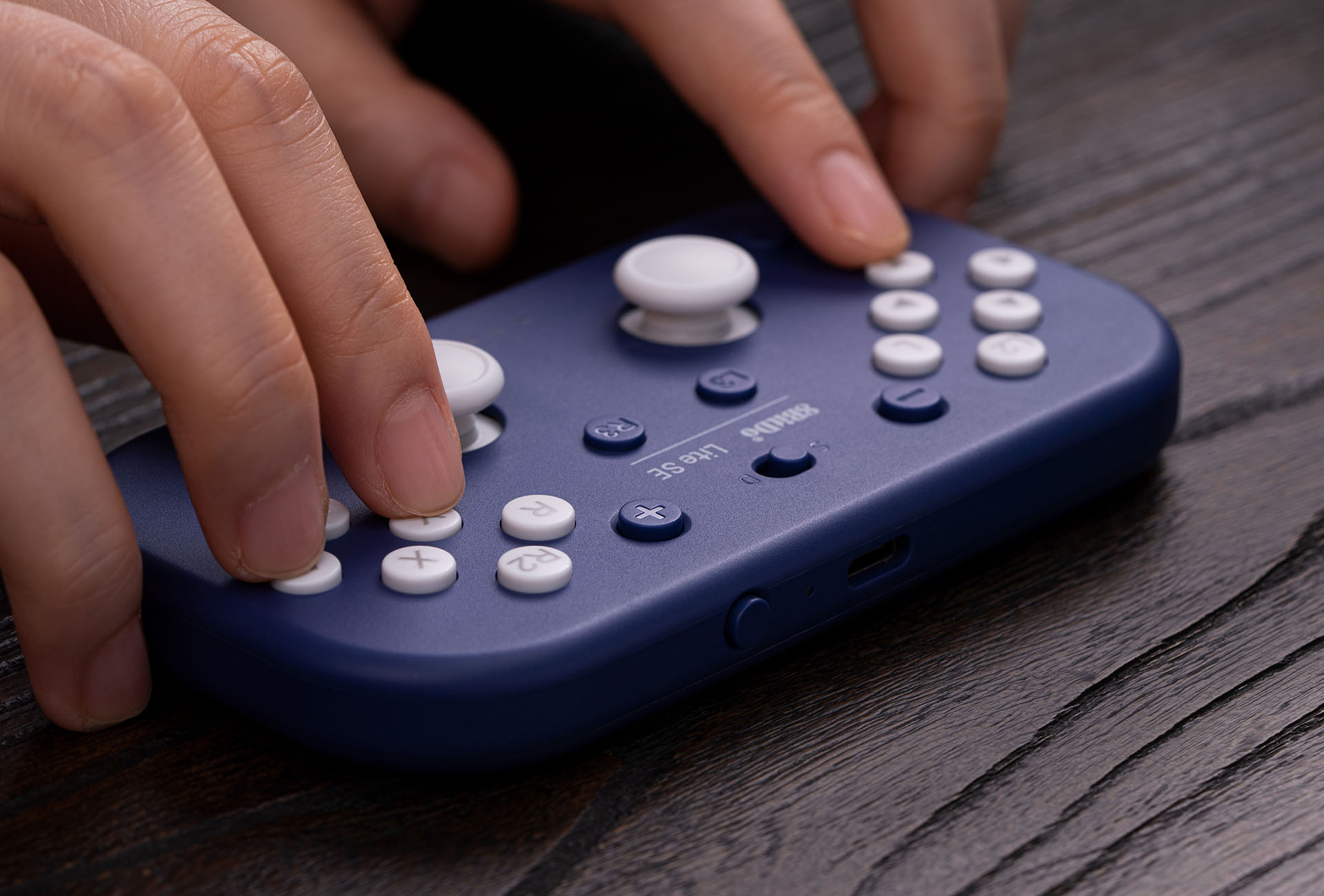
8BitDo Lite SE: Top Layout
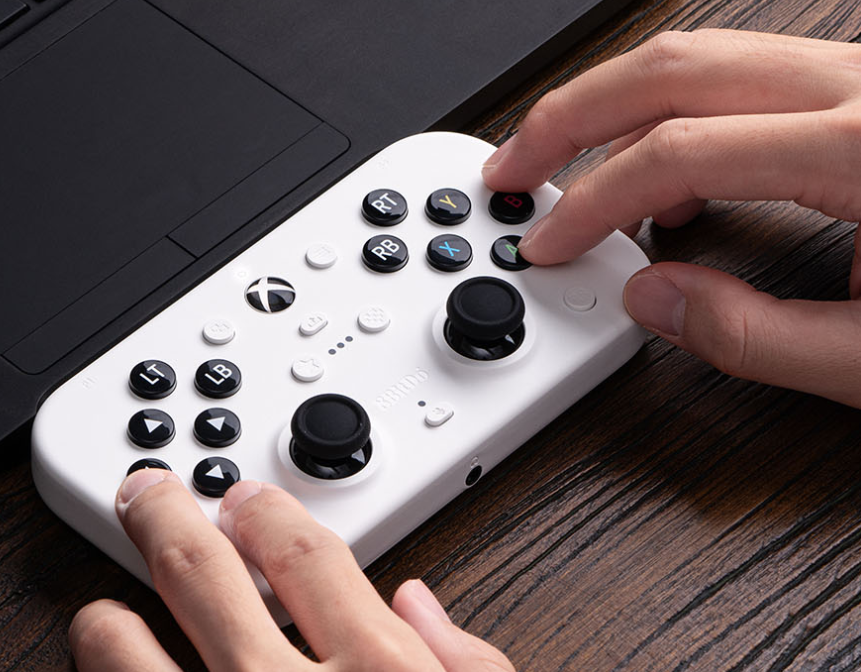
8BitDo Lite SE 2.4G: Top Layout
| Controller | Key Features |
|---|---|
| 8BitDo Lite SE | • Low-Resistance: Joysticks and buttons are much easier to press than standard components. • Flat Face Layout: L3/R3 and all triggers are moved to the front face for easy access. • Compatibility: Natively supports Nintendo Switch, Android, and PC. |
| 8BitDo Lite SE 2.4G | • Low-Resistance: Same as Lite SE • Flat Face Layout: Same as Lite SE. • Compatibility: Natively supports Xbox One, Xbox Series X|S, Android, and PC. |
Assistive Tech for Adaptive Controllers
The adaptive controllers above all allow for some amount of additional assistive tech to be connected and used as an input in the game. These are often (but not limited to) assistive switches and joysticks. Think of these the same as the buttons and thumbsticks on a standard controller but coming in a variety of shapes, sizes, forces, and types of activation.
Finding assistive technology that works for the player but also the adpative controller/platform you are playing on is crucial. Below are some resources to explain using assistive tech with adaptive controllers and where to find them.
Assistive Switches
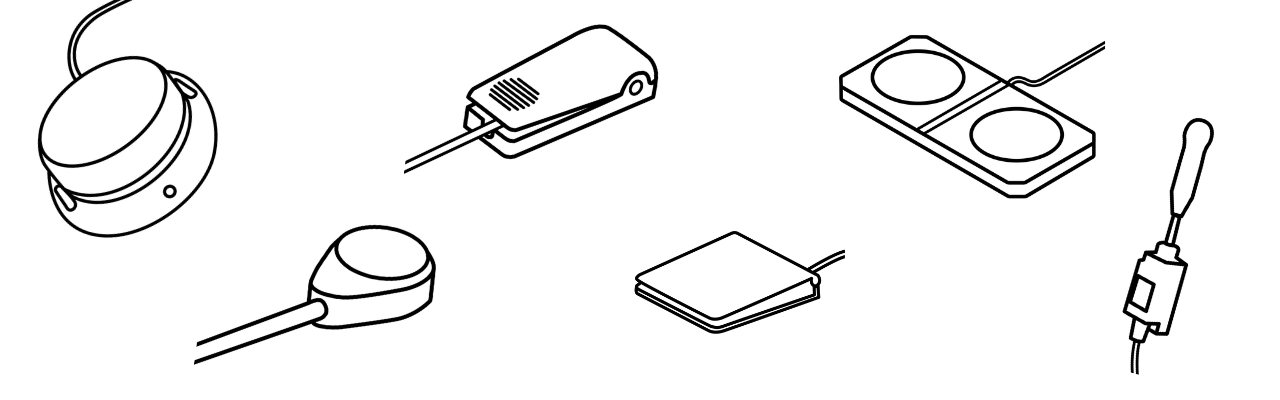
Assistive switches act as the primary bridge between a user’s physical movement and a digital action. At their core, they are simply external buttons that can be mounted in a convenient location for the user, targeting whichever part of the body has the most reliable and comfortable range of motion. Most assistive switches utilize a standard 3.5 mm cable to connect to adaptive controllers or switch interfaces.
In a gaming context, these switches replace the physical buttons on a standard controller or keyboard that may be inaccessible to the player. By using a combination of these external "access points" a gamer can reliably and comfortably trigger any in-game input, from jumping to firing a weapon, using the movements that work best for them.
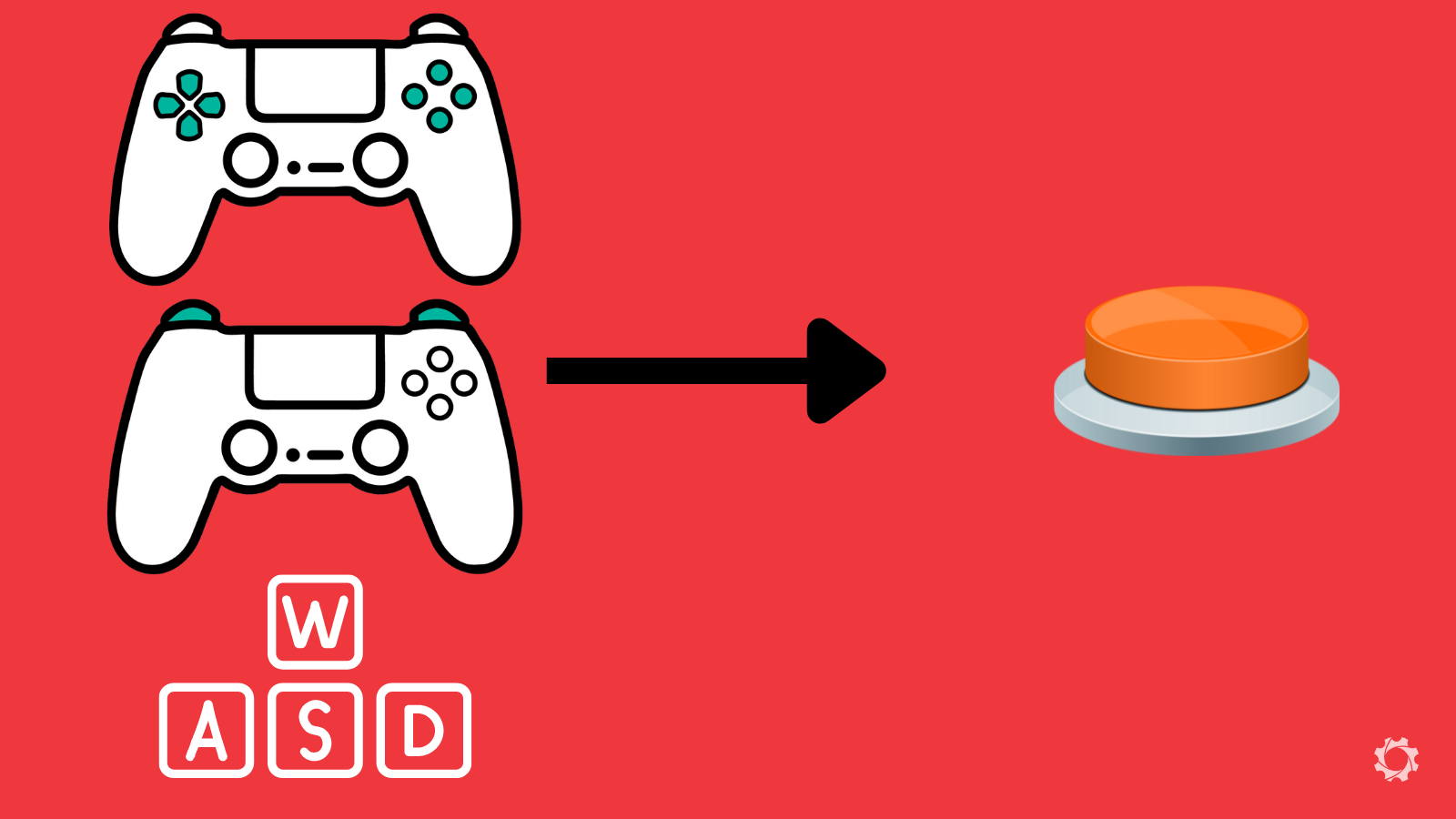
Keyboard or Controller Buttons can be Swapped to Buttons
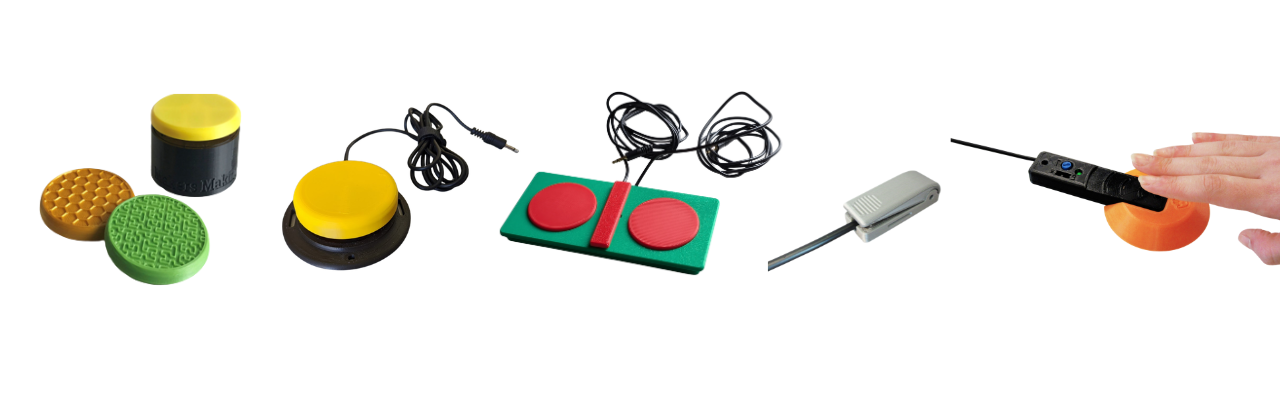
Various MMC Switches
Here are the criteria that often seperates the assistive switch options out there:
- Activation Force: The amount of pressure (measured in grams) required to "click" the switch.
- Target Shape: The switch activation area can have a smooth or specific tactile surface, curve, or custom shape.
- Target Size: The surface area available to hit; larger targets assist gross motor movements, while smaller targets allow for precise mounting.
- Travel Distance: How far the switch must physically move before it activates.
- Feedback: Whether the switch provides a tactile "click" or an audible sound to confirm the button was pressed.
- Mounting Type: How the switch attaches to the environment (e.g., threaded inserts for arms or flat bases for Velcro).
Below are some links to various places you can get assistive switches. Depending on where you live, there may be more options available. This is just a basic list of common places we use to get you started to find options out there.
Open Source/DIY Options
These options have been released under an open source license. This means anyone should have access to the files to build and create this device.
Assistive Switch - OpenAT Options
| Organization/Device | Description | Link |
|---|---|---|
| Makers Making Change | • We host several assistive switches in our library with various toppers and mounting options. • Most of these switches use a 3.5 mm cable. |
Search or filter the Assistive Devices for assistive switches |
| AbleGamers | • AbleGamers has a Printables page where they post designs | Link |
| Online Repositories | • You may be able to find designs and files from those who have shared them on various online repositories for sharing open source designs. • Printables and MakerWorld are a good starting place to look. |
Printables MakerWorld |
Commercial Options
Assistive Switch - Commercial Options
| Organization/Device | Description | Link |
|---|---|---|
| Logitech Adaptive Gaming Kit | • A very reasonably priced set of assistive switches with hook and loop mounting trays and stickers for labeling the switches. • There is a version for the SAC and XAC, but they both will work interchangably. The only difference is the quantity of the trays and switches in the kit and type of sticker packs. |
Link |
| OneSwitch | • Various assistive switches. | Link |
| Seven Mile Mountain | • Etsy page featuring various assistive switches. | Link |
| Pretorian | • Various assistive switches. | Link |
| HitClic | • Various assistive switches. | Link |
| Canadian Assistive Technologies | • Canadian vendor for assistive tech. | Link |
| Bridges Canada | • Canadian vendor for assistive tech. | Link |
Assistive Joysticks
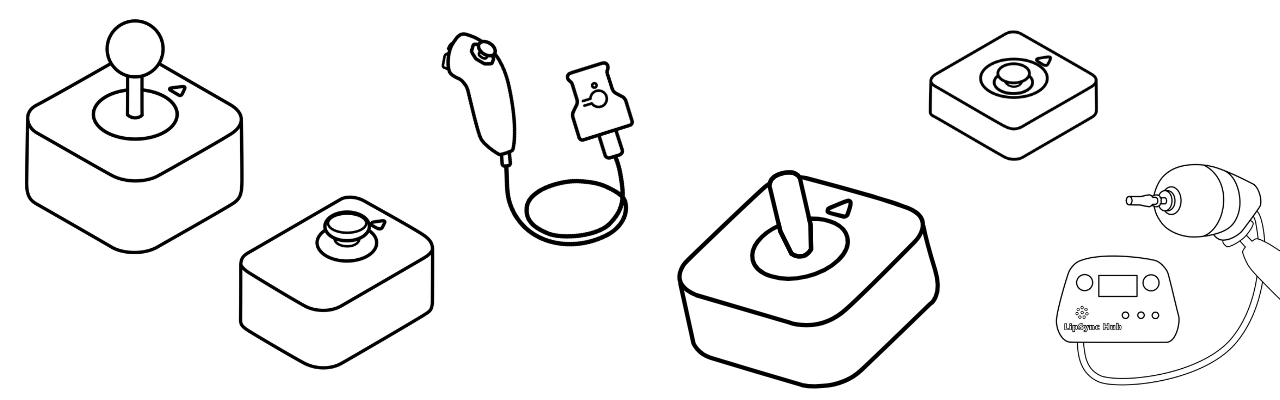
Assistive joysticks provide a way to replicate the directional movement usually found on a standard controller's thumbsticks. While a standard joystick is fixed to the controller, an assistive joystick can be positioned independently to be used by the hand, foot, chin, or any other reliable point of movement. These devices translate physical movement into digital "X and Y" coordinates, allowing the player to move their character or control the camera in-game.
In gaming, assistive joysticks typically connect via a USB cable OR a 3.5 mm cable.
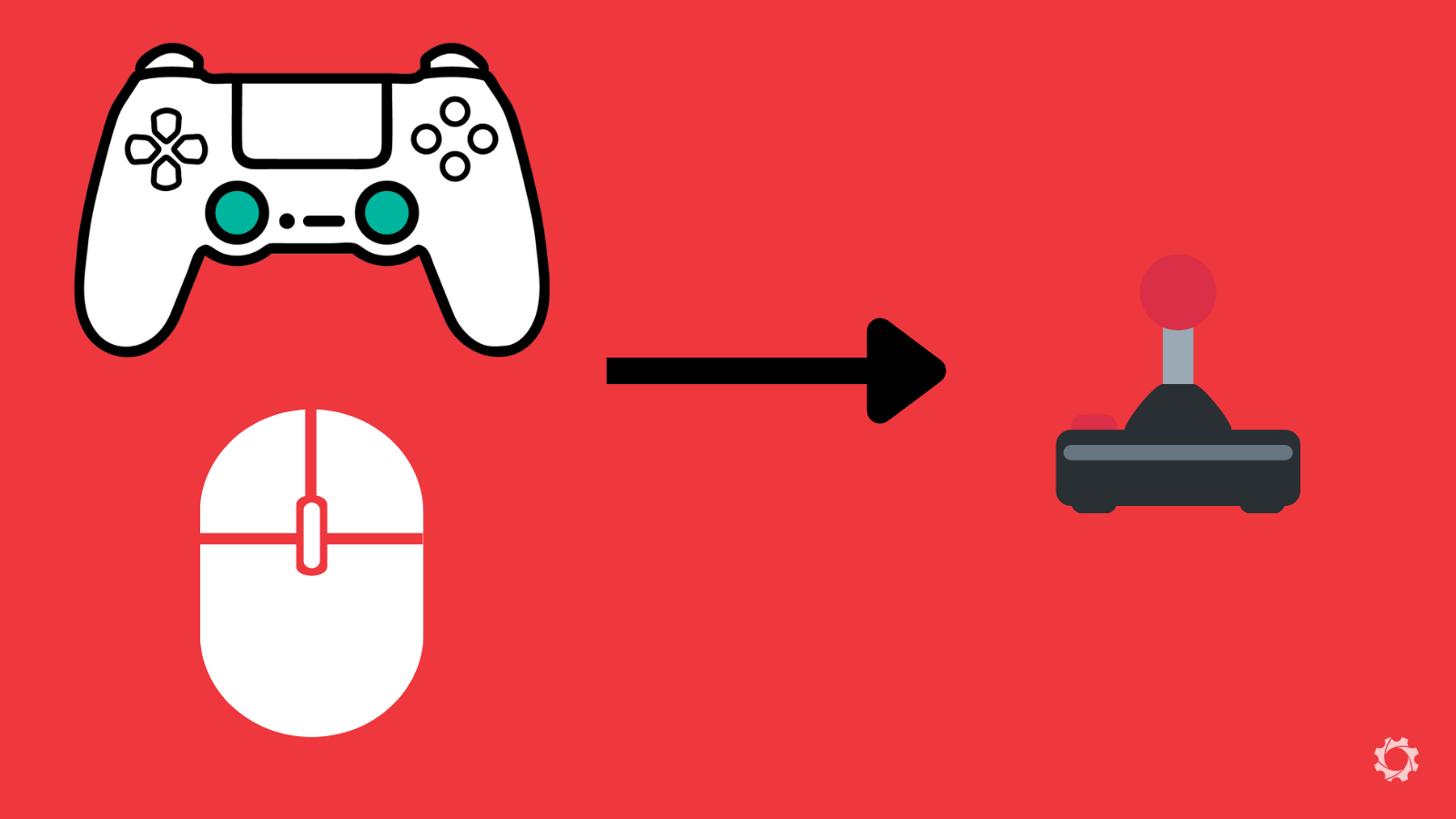
Mice or Controller Joysticks can be Swapped to Assistive Joysticks
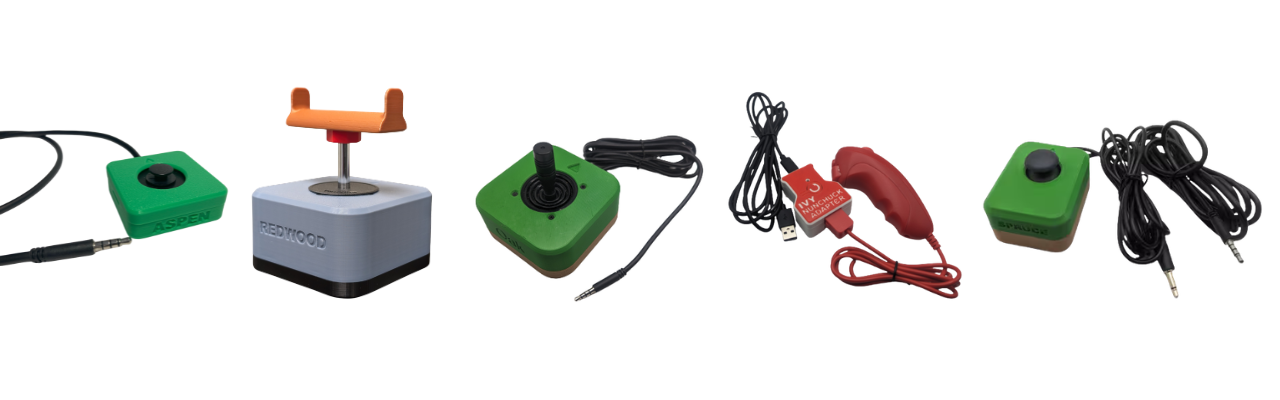
Various MMC Joysticks
Here are the criteria that often separate the assistive joystick options out there:
- Force Required: The amount of physical strength needed to move the stick from the center position. Some "low force" sticks can be moved with a feather-touch, while others offer more resistance.
- Range of Motion (Throw): The distance the joystick must physically tilt to reach to provide input in the game.
- Digital vs. Analog:
- Analog: Responds to how far you push; move a little to walk, move a lot to run. Proportional control in all directions.
- Digital: Responds only to direction (like a D-pad); it is either "on" or "off.". Some work in 4 directions (up, down, left, right) and some work in 8-way (up, down, left, right, and the 4 diagonals)
- Topper Style: The physical shape of the handle (e.g., ball top, goalpost, or dome) which may be able to be swapped to match the user's prefered grip.
- Input Connection: Whether it uses a USB plug for direct-use/hubs or a 3.5 mm jack for specific adaptive ports.
- Mounting Type: How the base is secured, such as 1/4-20 threaded inserts for mounting arms, hook and loop, etc.
Below are some links to various places you can get assistive joysticks. Depending on where you live, there may be more options available. This is just a basic list of common places we use to get you started to find options out there.
Open Source/DIY Options
These options have been released under an open source license. This means anyone should have access to the files to build and create this device.
Assistive Joystick - OpenAT Options
| Organization/Device | Description | Link |
|---|---|---|
| Makers Making Change | • We host several assistive joysticks in our library with various toppers and mounting options. • Some of these joysticks are USB and some are 3.5 mm (TRRS). |
Search or filter the Assistive Devices for Joysticks |
| AbleGamers | • AbleGamers has a Printables page where they post designs | AbleGamers Printables Page |
| Online Repositories | • You may be able to find designs and files from those who have shared them on various online repositories for sharing open source designs. • Printables and MakerWorld are a good starting place to look. |
Printables MakerWorld |
Mouth Joysticks
These are joysticks that are intended to be used with someones mouth or face. Most of the time, they include a sip and puff feature where people can breath in and out into the device to have inputs into the game.
There are two prominent options for mouth joysticks when it comes to gaming:
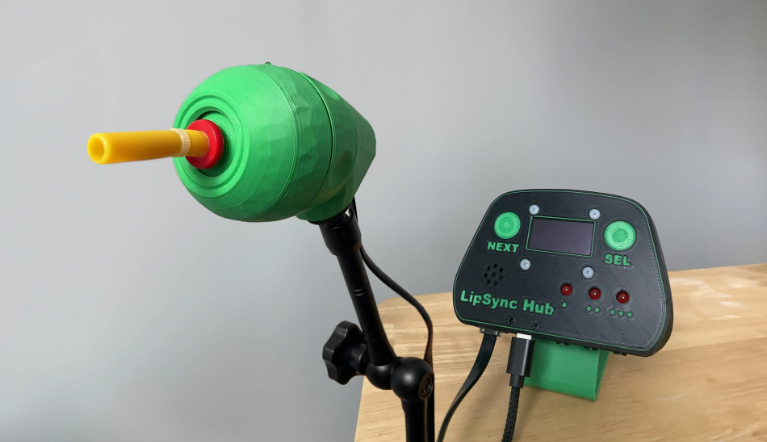
LipSync by Makers Making Change
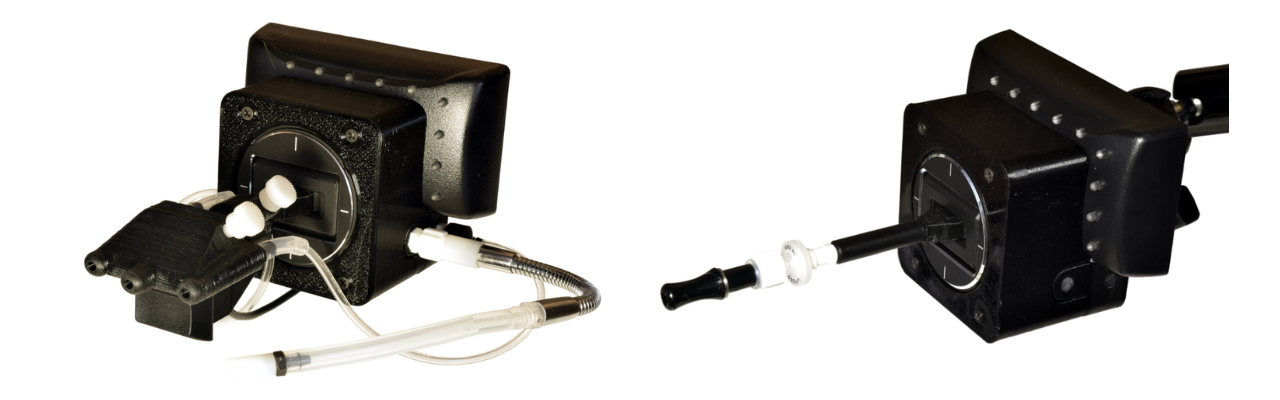
Quadstick FPS Game Controller
Mouth Joystick Comparison
| Mouth Joystick | Approx Cost | Features | Considerations | Link |
|---|---|---|---|---|
| LipSync | $250 | • Light Force Joystick: Requires very little physical pressure, making it ideal for users with limited head/neck strength. • Sip and Puff: Single port system utilizing timed pressure (short, medium, long) for both sips and puffs to trigger distinct inputs. • Interactive Hub: Features 3 assistive switch ports, a built-in speaker for audio feedback, and a screen for visual settings. • User Independence: Users can access the Hub Menu independently to switch modes, calibrate, or adjust sensitivity without a PC. • Multiple Modes: Supports USB Mouse, Bluetooth Mouse, and USB Gamepad modes for versatile platform support. • Adjustable Angle: <br• Compatibility: Operates as a USB/Bluetooth mouse or USB Gamepad. It can plug into an Xbox Adaptive Controller (XAC) to bridge to consoles via adapters. |
• A single sip/puff port can limit the speed of inputs in fast-paced games where multiple simultaneous actions are required. | LipSync Page See it in Action |
| Quadstick (FPS) | ~$750 + fees | • Sip and Puff: Features four independent sip/puff sensors and a lip position sensor for complex, simultaneous commands. • Custom Mapping: Supports extensive macro profiles and "latching" inputs, allowing users to trigger complex button combos with a single breath. • Compatibility: Works natively with PC, PS3, PS4, and Nintendo Switch; compatible with Xbox and PS5 via adapters. |
• Significant learning curve due to the complexity of breath-combination "codes." • Frequently out of stock due to high demand. • Mapping software has a learning curve. • There are a few different versions on the site. |
Quadstick Page See it in Action |
Commercial Options
Assistive Joystick - Commercial Options
| Organization/Device | Description | Link |
|---|---|---|
| Xbox Adaptive Joystick | • Developed by Xbox for the XAC. Compatible on its own to a computer, phone, or Xbox device. | Link |
| Designed by Grier | • Various assistive joysticks. | Link |
| Celtic Magic | • Products include the Feather Joystick (ultralight force) and Dangle Joystick (light force and low profile). | Link |
| OneSwitch | • Various assistive joysicks. | Link |
| Seven Mile Mountain | • Etsy page featuring various assistive joysticks. | Link |
| Pretorian | • Various assistive joysticks. | Link |
| HitClic | • Various assistive joysticks. | Link |
| Canadian Assistive Technologies | • Canadian vendor for assistive tech. They sell the Pretorian joysticks here too. | Link |
| Bridges Canada | • Canadian vendor for assistive tech. They sell the Pretorian joysticks here too. | Link |
Other Input Methods
If standard adaptive controllers, assistive switches, or specialized hardware do not meet all of a player's needs, consider integrating eye tracking, voice control, or gesture control. These "alternative inputs" can be used as standalone solutions or in combination with other AT to expand the total number of reliable inputs available to the player.
Eye Tracking
Eye tracking technology allows a player to control a cursor or trigger game actions simply by looking at specific areas of the screen. While powerful, it often requires specialized hardware and software to translate "gaze" into the complex button presses required for modern gaming.
Check out this video from Adaptive Hacker Khan using a Tobii Eye Tracker as a game input using Millmouse and Project Iris
Eye Tracking Resources
| Platform | Description | Link to Resource |
|---|---|---|
| PC / Computer | Tobii Eye Trackers: The hardware standard for eye tracking. For full game control, it is often paired with software like Millmouse or Project Iris to convert gaze into mouse movements and clicks (see resource). | Tobii Eye Trackers Tutorial using eye tracker for full game access |
| PC / Computer | SpecialEffect Eye Gaze Games: A collection of browser-based and downloadable games designed specifically to be played entirely via eye tracking. | Eye Gaze Games |
| Consoles | Hori Flex (Nintendo Switch): The Hori Flex can be configured to accept eye-tracking inputs through specific PC-bridge setups. Refer to SpecialEffect resources for detailed wiring diagrams and "Eye Gaze to Switch" conversion methods. | SpecialEffect Hori Flex Guide |
Voice and Gesture Control
Voice and gesture recognition software translates spoken commands or physical movements (like a head tilt or a blink) into digital controller inputs. This is a rapidly evolving field that frequently uses AI to interpret a player's unique range of motion.
Check out this video from Cephable on using their software with Call of Duty: Black Ops 7 to use voice, button, and facial gesture input.
Voice and Gesture Control Resources
| Tool | Description | Link |
|---|---|---|
| Cephable | Multimodal Input: An all-in-one platform that turns head movements, facial expressions, quick action buttons, and voice into inputs for PC and consoles. It features a highly customizable app to tune sensitivity and create macros. | Cephable |
| Playability | Face & Voice Control: Uses a standard webcam to map facial expressions and voice commands to play PC games and even PlayStation, Xbox & Switch via Remote Play or adapters. This allows a player to "smile" to jump or use voice cues to trigger inputs. | Playability Adaptive Software |
Important Considerations
The absolute crucial components of any alternative access setup are mounting and adapters. You can have the perfect selection of gear, but if you cannot securely position it where the player can reach it, the setup is practically useless. Likewise, if the hardware is perfect but doesn't talk to the console, it won't get the player into the game.
Mounting
Mounting is the process of securing controllers, switches, joysticks, or other assistive tech in a specific location that matches the player's reliable range of motion. Whether it’s on a wheelchair tray, a table, or a bed frame, the goal is "rock-solid" stability so the gear doesn't move during intense gameplay.
Below are a few common ways to approach this.
Hook and Loop
The most common starting point. Uses industrial-strength hook and loop to attach gear to lapboards or trays. It is highly adjustable and low-cost. You can start by taking a laptop tray, wheelchair tray, 3D printed surface and placing hook and loop fastener on it and the bottom of your assistive tech.
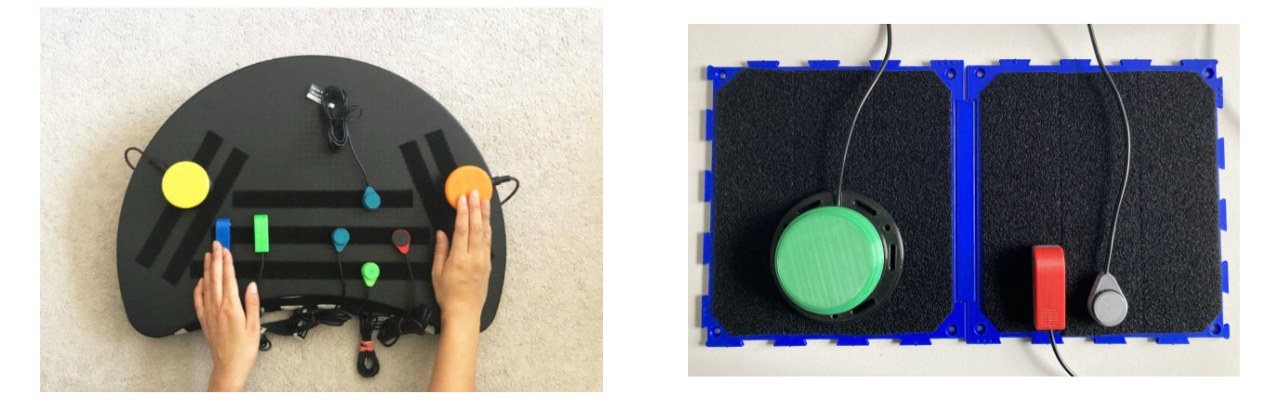
Ikea laptop Tray with Hook and Loop Added to it (left) and MMC Connect Board (right)
Articulating Arm
Arms that can be clamped to desks or wheelchairs. They allow for "3D" positioning, placing a the assistive tech exactly where it needs to be. There is a range of how sturdy these can be depending on the quality and design of the arm.
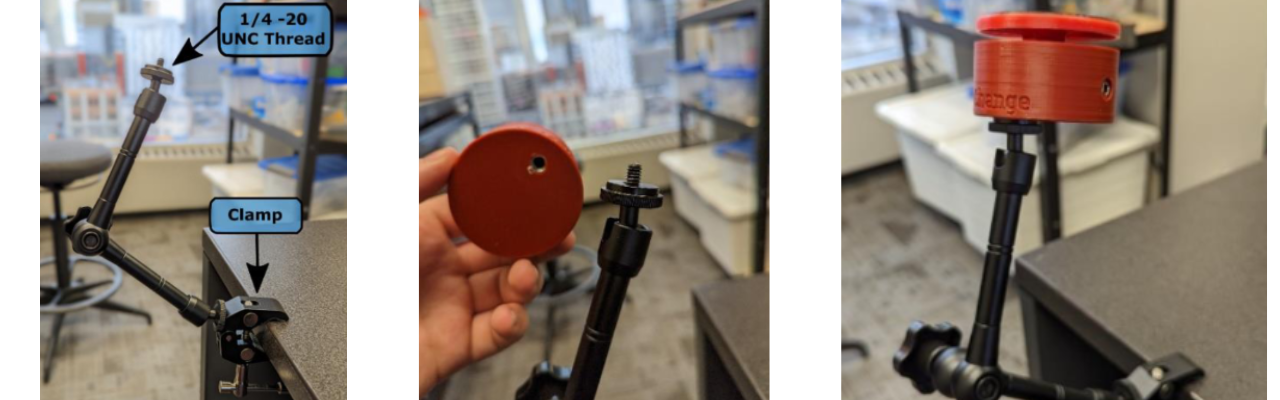
Using an Articulating Arm with a MMC60 Switch
RAM Mounts
RAM mounts are modular ball-and-socket system known for extreme durability. AbleGamers created a series of adapters for common standard controllers to make them compatable with RAM mounts. It would also be possible have a flat plate at the end of the RAM attachment facing the user and put hook and loop fastener on it to attach assistive tech as well.
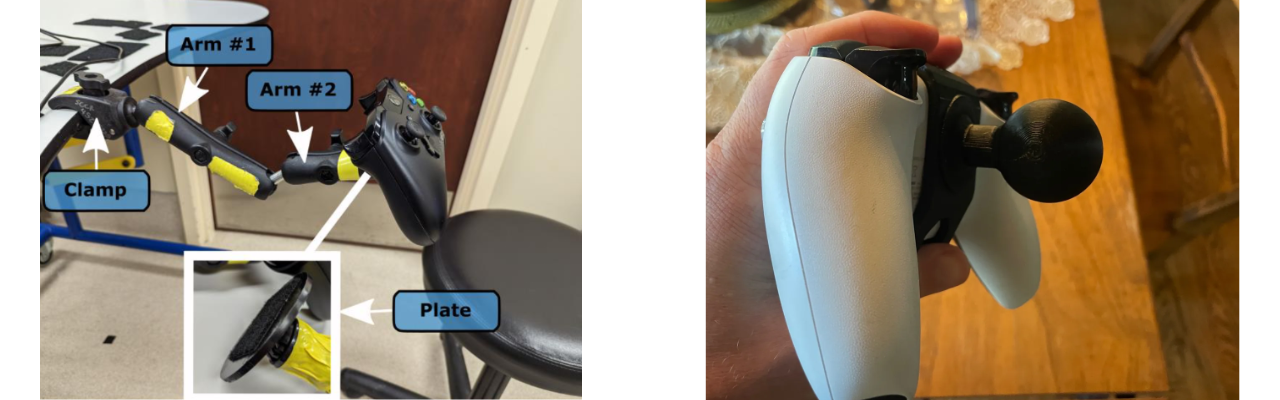
Hook and Loop on a flat plate using RAM Arms (left) and AbleGamers 3D print RAM Attachment to Controllers (right)
Adapters
Adapters act as the "translator" between your standard controller, adaptive controller, or specalized controller to a specific platform they are not initally designed for. They are essential when using a controller or setup designed for one platform (like an Xbox Adaptive Controller) on a different one (like a PlayStation 5 or Nintendo Switch).
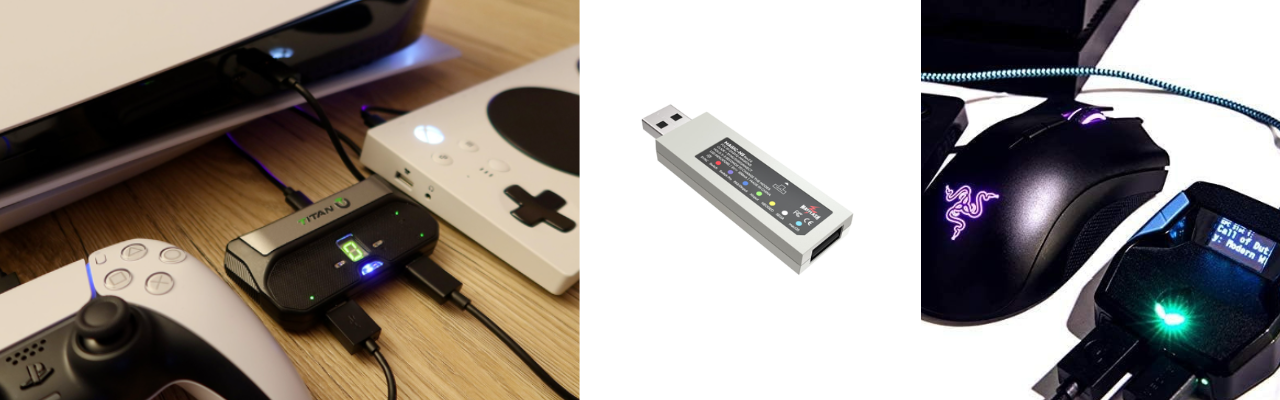
Various Adapters
How to Find the Correct Adapter
Below are the main resources that our team uses to find an adapter that allows one controller to connect to a platform that it was not initially designed for.
Resources to Find Adapters
| Tool | Description | Link |
|---|---|---|
| Gaming Readapted - Controller Connect Tool | A great resource for checking which adapters currently work with which consoles. This site is updated frequently as console firmware changes but may be slightly out of date. | Controller Connect Tool |
| Brook Gaming | Brook makes adapters and has several options. A good starting place. | Brook Website |
| Brook FGC2 | This is the adapter we use most often to get the XAC to work with the PS5. | Brook FGC2 Website |
| Mayflash Magic NS2 | This is the adapter we use most often to get the XAC to work with the Nintendo Switch 1 or 2. | Maylfash Magic NS2 |
| Cronus Zen | This adapter takes a different approach by using a "validating controller". It also has software to program things like macros. Also a good option to explore. | Cronus Zen Website |
Adapters Go Out of Date
Console manufacturers often release firmware updates that can "break" third-party adapters. Always check the latest community forums before purchasing a specific adapter to ensure it still works with the latest system version.

Want to learn more about this program or request a device?
Copyright © 2026 Neil Squire / Makers Making Change. Content is licensed under the CC BY SA 4.0 License. This website is built with MKDocs. MKDocs is MIT-licensed software and is not covered by the CC BY-SA license applied to this site's content.
Visit Makers Making Change